

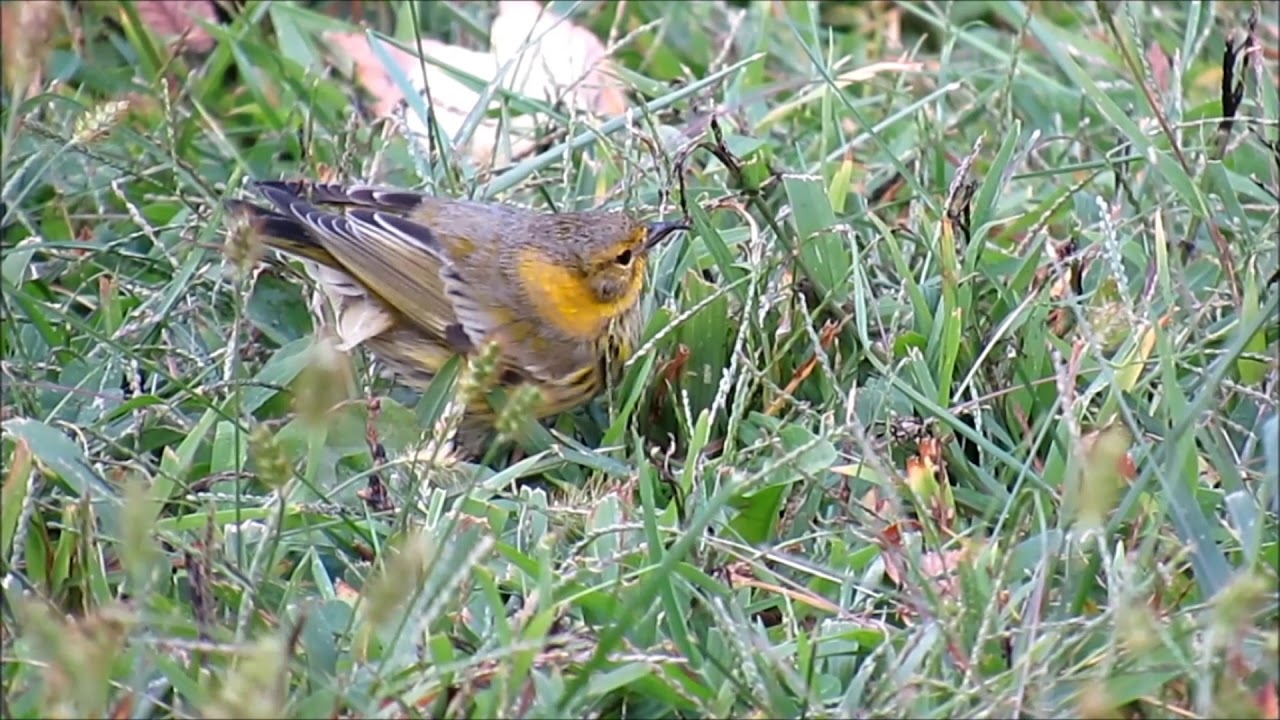
 A migrating Cape May Warbler with a deformed crossed bill gets an insect while feeding in the grass. October 4, 2019, Governors Island, New York City. "Breeding Cape May Warblers feed almost entirely on invertebrates, chiefly spruce budworm, which may form half of the diet or more. They might be considered spruce budworm specialists, as their populations rise and fall sharply with the prevalence of this pest of the boreal forest. They also consume spiders, beetles, wasps, flies, ants, bees, moths, leafhoppers, scale insects, aphids, and many other sorts of insects. They capture most prey by probing and picking while perched, but they also chase flying insects and occasionally hover-glean prey from the tips of branches. They share their habitat with other warblers, including Bay-breasted, Blackpoll, Magnolia, and Blackburnian, but during the breeding season, Cape May tends to forage in the treetops, in the outer portion of the tree. As their delicate, slightly decurved bill shape might suggest, Cape May Warblers are adroit in probing blossoms for insects and for taking nectar from flowers, which they do aided by their long, curled tongues. Migrants take nectar from plants as diverse as tulip poplar, black cherry, and willow, and wintering birds sip nectar at bottlebrush, agave, and many native and ornamental flowers. Cape May Warblers also eat fruit. In tropical areas, they take Cecropia fruit and other small berries including grapes. In backyards, they relish hummingbird nectar, fresh fruit, fruit jelly, sap (from wells made by sapsuckers), and mealworms. Fruit and nectar make up about a third of the diet in the nonbreeding season. During the nonbreeding months, Cape May Warblers frequent all levels of the forest and are often seen at eye level in coffee plantations and ornamental plantings." The Cornell Lab of Ornithology
 Music by: wishsnakeheyu


0 Comments